
The mosque shooting near San Diego is yet another reminder that the extremist landscape is changing in ways most people do not understand.
As details emerge, the case reveals a disturbing mix of ideological influences connected to accelerationism, incel culture, online violent extremist networks, and nihilistic subcultures that glorify death, cruelty, and destruction.
What makes these movements particularly dangerous and harder to understand is that they do not fit into traditional political categories.
This is not conventional “left, right, or religious” extremism. It is something much darker.
A growing ecosystem of nihilistic violent extremism that pulls together the worst elements of multiple ideologies into a culture of hate, chaos, alienation, and destruction.
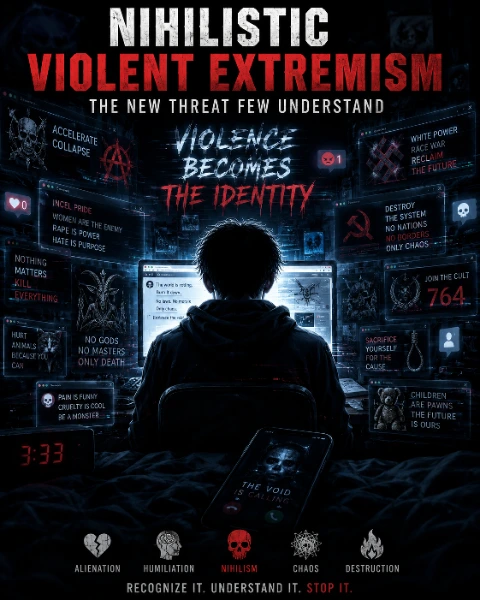
Adding to the confusion, groups connected to accelerationism, occult extremism, incel ideology, and online violence networks frequently blend beliefs that historically oppose one another:
- Nazism.
- Anarchy.
- Communism.
- Satanism.
- Racial hatred.
- Misogyny.
- Apocalyptic fantasies.
The glaring contradictions seemingly do not matter to those involved. Why? Because ideology itself is not the primary driver.
Violence becomes the identity.
One of the most disturbing aspects of these nihilistic extremist ecosystems is the glorification of cruelty itself. Many of these networks promote extreme misogyny, sexual violence, humiliation, psychological abuse, animal cruelty, self-harm, and even the exploitation or abuse of children as forms of power, shock, or initiation.
In many of these spaces, rape is encouraged not merely as violence, but as a weapon of domination and dehumanization. Vulnerable young men are often manipulated through humiliation, isolation, addiction, identity crises, and deep-seated hatred toward women and civil society itself.
This is one reason incel culture and nihilistic violent extremism increasingly overlap.
The goal is not simply political revolution.
The goal becomes emotional numbing, destruction, and the abandonment of empathy itself. That is one reason these movements are so difficult for the public, law enforcement, researchers, and media to understand.
People naturally categorize extremism into familiar boxes:
- Far-right.
- Far-left.
- Religious extremism.
- Racial extremism.
Nihilistic violent extremism functions differently. It feeds on alienation, humiliation, hopelessness, and social isolation, culminating in a desire to destroy both society and self.
Many young people drawn into these dark spaces are not searching for coherent political philosophy. They are searching for belonging, identity, shock value, power, and martyrdom through destruction.
Online ecosystems accelerate this process.
Algorithms, encrypted communities, violent propaganda, humiliation rituals, and digital echo chambers often push vulnerable individuals deeper into extreme material. Many of these networks intentionally encourage adherents to abandon morality altogether and embrace chaos, terrorism, suicide, murder, or societal collapse as forms of “purpose.”
This is why these movements absorb influences from wildly contradictory ideologies simultaneously. The common denominator is not political consistency.
It is dehumanization. Rage. Nihilism.
Which makes them extraordinarily difficult to predict, track, and counter.
These movements increasingly resemble decentralized digital death cults more than traditional political organizations.
The recent mosque shooting also demonstrates another uncomfortable reality: extremism and radicalization can exist in multiple spaces simultaneously. Acknowledging concerns about extremist rhetoric or radical influences in one environment should never be confused with justifying violence against innocent people.
We cannot meet hate with more hate, or one form of extremism with another.
The answer to dehumanization cannot be more dehumanization.
I spent decades leading an extremist movement, and one thing I learned is that hatred wears many different masks and attaches itself to different symbols and causes. But it almost always leads to the same place: destruction of self and others.
Parents, educators, and communities should pay close attention to warning signs that may indicate a young person is being exposed to these ecosystems:
- obsession with extreme violence,
- fixation on mass killers or terrorist propaganda,
- celebration of cruelty,
- violent misogyny,
- sadistic humor,
- encouragement of self-harm,
- or cruelty toward animals and vulnerable people.
Not every troubled teenager becomes radicalized. But repeated exposure to online communities that normalize dehumanization can gradually erode empathy, morality, and human connection.
Radicalized youth were not born hateful. They were psychologically consumed over time by digital environments that reward alienation, rage, nihilism, and cruelty.
To confront this growing threat effectively, we first need to understand what we are actually dealing with.
On a societal level, what we are facing is not simply radicalization. It is moral collapse fused with nihilism, amplified by digital ecosystems that reward cruelty, violence, humiliation, and spectacle.
These movements prey upon alienation, identity crises, isolation, hopelessness, and the human need for belonging. They do not simply radicalize young people politically. They condition them psychologically and emotionally to detach from empathy itself.
If society continues treating this threat through outdated ideological frameworks alone, we will continue misunderstanding the danger until more lives are destroyed. Because at its core, nihilistic violent extremism is not about politics. It is about the celebration of meaninglessness, cruelty, and destruction.
If we fail to recognize this threat for what it is, more young people will be pulled into spaces that teach them to see cruelty as purpose, violence as identity, and destruction as belonging.